
A Research Outcome of the MoU between Tokyo University of Technology and Burapha University ― International Joint Research Paper Receives Best Paper Award at SNPD2026 ―
A paper coauthored by Professor Takafumi Nakanishi of the Faculty of Computer Science at Tokyo University of Technology and four members of the Faculty of Informatics at Burapha University, Thailand, received the Best Paper Award.
The Burapha University coauthors are Asst. Prof. Pusit Kulkasem, Dean of the Faculty of Informatics; Dr. Watcharaphong Yookwan; Assoc. Prof. Dr. Krisana Chinnasarn; and Assoc. Prof. Dr. Suwanna Rasmequan.
The award was presented at the 34th IEEE/ACIS International Conference on Software Engineering, Artificial Intelligence, Networking and Parallel/Distributed Computing (SNPD2026), held at Okayama University, Japan, from August 22 to 24, 2026.
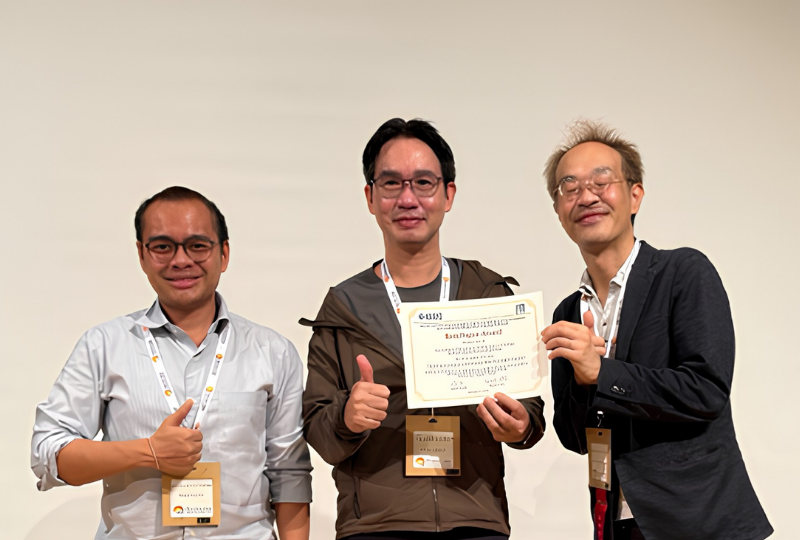
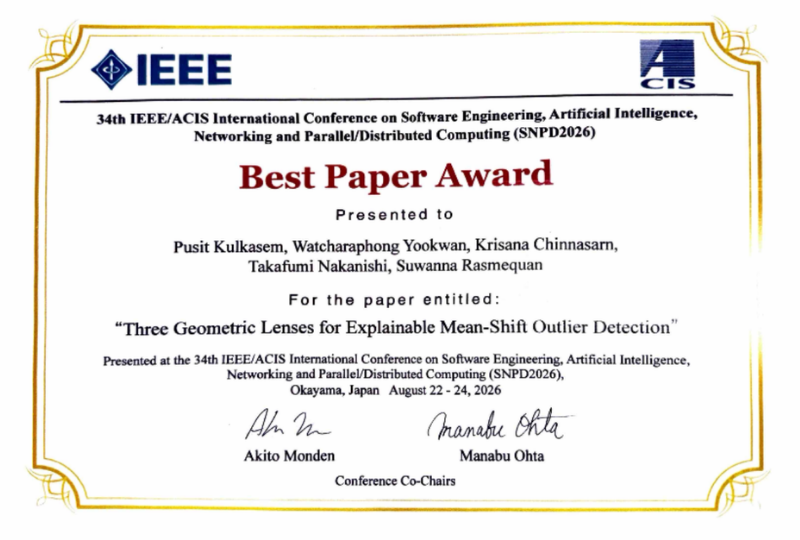
The award-winning paper is entitled “Three Geometric Lenses for Explainable Mean-Shift Outlier Detection.”
The study proposes a new approach for explaining which features influence the score assigned to a data point identified as an outlier by a machine-learning method.
Mean-Shift Outlier Detection (MOD) identifies unusual data points by measuring how far each point moves toward neighboring data during an iterative mean-shift process.
However, conventional MOD and its extension, MOD+, return only a single outlier score.
They do not directly show which features influenced the score or at which stage of the iterative process those influences arose.
To address this limitation, the researchers developed three explanation algorithms called the “Three Geometric Lenses.”
The first lens shows how much each feature contributes to the outlier score.
The second identifies which features contribute at each mean-shift iteration.
The third finds the smallest number of features that must be changed to bring the outlier score below a specified threshold.
By exploiting the geometric structure of MOD and MOD+, the three algorithms provide exact explanations under the conditions addressed in the study while keeping computation fast.
In the experiments reported in the paper, the proposed feature-attribution method ranked first or second across all eight evaluation metrics on four benchmark datasets for faithfulness to a frozen-displacement score.
Its processing time was under 10 milliseconds per sample.
Under the comparison conditions used in the paper, the method for finding the minimum number of feature changes also showed favorable results in validity, number of changed features, and runtime compared with an existing counterfactual explanation method.
This achievement is a research outcome of the collaboration advanced under the comprehensive Memorandum of Understanding (MoU) in the field of AI signed by Tokyo University of Technology and Burapha University on July 2, 2025.
The two universities will continue to strengthen international collaboration in AI through joint research and exchanges among researchers and students.
■Proposed Comment from Professor Takafumi Nakanishi
We have already conducted very in-depth research with the faculty at Burapha University, and we are delighted to see the results of that effort come to fruition. In this paper, by utilizing the geometric structure of the detector under study, we were able to rigorously demonstrate which features contributed to the outlier score at each stage. Encouraged by receiving the Best Paper Award, we will continue to advance our joint research and foster exchanges between researchers and students under the terms of our Memorandum of Understanding (MoU).
■Award-Winning Paper
Title: Three Geometric Lenses for Explainable Mean-Shift Outlier Detection
Authors: Pusit Kulkasem, Watcharaphong Yookwan, Krisana Chinnasarn, Takafumi Nakanishi, and Suwanna Rasmequan
Affiliations: Faculty of Informatics, Burapha University, Thailand; Faculty of Computer Science, Tokyo University of Technology, Japan
Conference: 34th IEEE/ACIS International Conference on Software Engineering, Artificial Intelligence, Networking and Parallel/Distributed Computing (SNPD2026)
Dates: August 22–24, 2026
Venue: Okayama University, Okayama, Japan
Award: Best Paper Award
■Related Links
Tokyo University of Technology and Burapha University Sign a Comprehensive MoU in AI:https://www.teu.ac.jp/information/2025.html?id=162
Official SNPD 2026 Website:https://acisinternational.org/conferences/snpd-2026-i/
https://www.teu.ac.jp/grad/cs/index.html