
Tokyo University of Technology Professor Takeshi Matsui and Visiting Researcher Hiroyuki Sasaki Participate in Collaborative Research — Second Mechanism of Action of the Long-Acting HIV Drug Lenacapavir Elucidated —
Professor Takeshi Matsui and Visiting Researcher Hiroyuki Sasaki of the Cosmetics Course, School of Bioscience and Biotechnology, Bionics Program, Tokyo University of Technology, participated in a research group that has elucidated a previously unknown second antiviral mechanism of action of the long-acting HIV drug lenacapavir (LEN).
Lenacapavir is a long-acting therapeutic agent that potently suppresses the replication of HIV-1, the virus that causes AIDS (acquired immunodeficiency syndrome). It targets the capsid protein, which forms the framework of the virus particle. LEN was previously known to inhibit the series of steps from viral entry into a target cell to the integration of the viral genes into the genome of the target cell. However, the second mechanism of action underlying its potent antiviral effect had remained unknown.
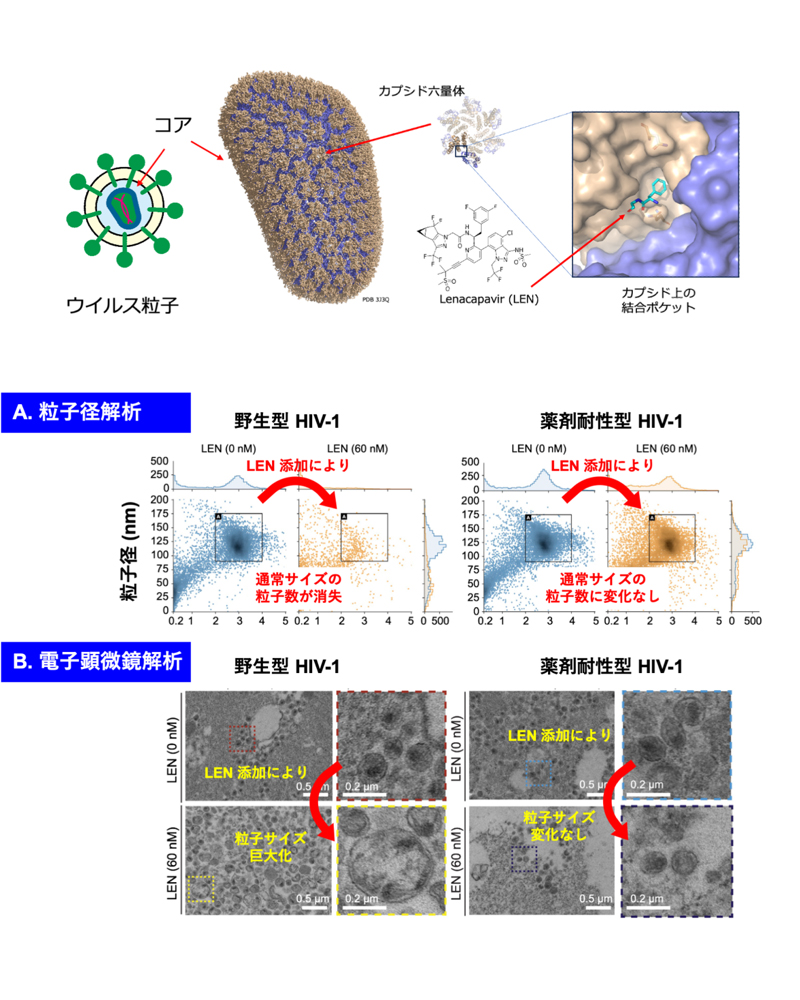
Professor Matsui and Visiting Researcher Sasaki, together with Senior Lecturer Kazuaki Monde of the Faculty of Life Sciences, Kumamoto University, Professor Yasumasa Iwatani of Hamamatsu University School of Medicine, and other researchers, used particle size measurement technology and electron microscopy to demonstrate that lenacapavir binds to the capsid precursor protein during virus particle formation and promotes the formation of giant virus-like particles.
Furthermore, the researchers found that the giant virus-like particles, exceeding 200 nm in diameter, formed in the presence of lenacapavir retain the ability to enter target cells but are non-infectious. These findings demonstrate that lenacapavir acts during the virus particle formation process and induces the formation of giant, non-infectious virus-like particles, revealing its second antiviral mechanism of action.
These findings not only deepen our understanding of the mechanism of action of lenacapavir but are also expected to contribute to the development of more potent next-generation antiviral drugs by applying this newly identified principle of action.
This research was conducted as a collaboration among the Department of Microbiology, Faculty of Life Sciences, Kumamoto University; the Department of Microbiology and Immunology, Hamamatsu University School of Medicine; the Laboratory for Viral Infection Control, Frontier Science Research Center, University of Miyazaki; the Department of Infectious Diseases and Immunology, Clinical Research Center, National Hospital Organization Nagoya Medical Center; the Laboratory for Evolutionary Cell Biology of the Skin, Cosmetics Course, School of Bioscience and Biotechnology, Bionics Program, Tokyo University of Technology; and the Joint Research Center for Human Retrovirus Infection, Kumamoto University.
Paper Information
Journal: Proceedings of the National Academy of Sciences of the United States of America (PNAS)
Paper Title: Lenacapavir binding to immature Gag induces giant virions and causes protease-dependent inhibition of viral release
Authors: Wright Andrews Ofotsu Amesimeku, Yoshihiro Nakata, Nami Monde, Hiromi Terasawa, Hirotaka Ode, Hiroyuki Sasaki, Consolata Elias Rukondo, Takeshi Matsui, Perpetual Nyame, Md. Jakir Hossain, Akatsuki Saito, Tomohiro Sawa, Terumasa Ikeda, Yosuke Maeda, Yasumasa Iwatani, Kazuaki Monde
DOI: https://doi.org/10.1073/pnas.2609634123
Related Links
Kumamoto University Press Release: “Second Mechanism of Action of the Long-Acting HIV Drug Lenacapavir Elucidated — A Clue to Understanding the Drug's High Efficacy —”
https://www.kumamoto-u.ac.jp/whatsnew/seimei-sentankenkyu/20260907
School of Bioscience and Biotechnology, Tokyo University of Technology:
https://www.teu.ac.jp/gakubu/bionics/index.html
Takeshi Matsui Lab:
https://takeshi-matsui-lab.bs.teu.ac.jp/?page_id=311